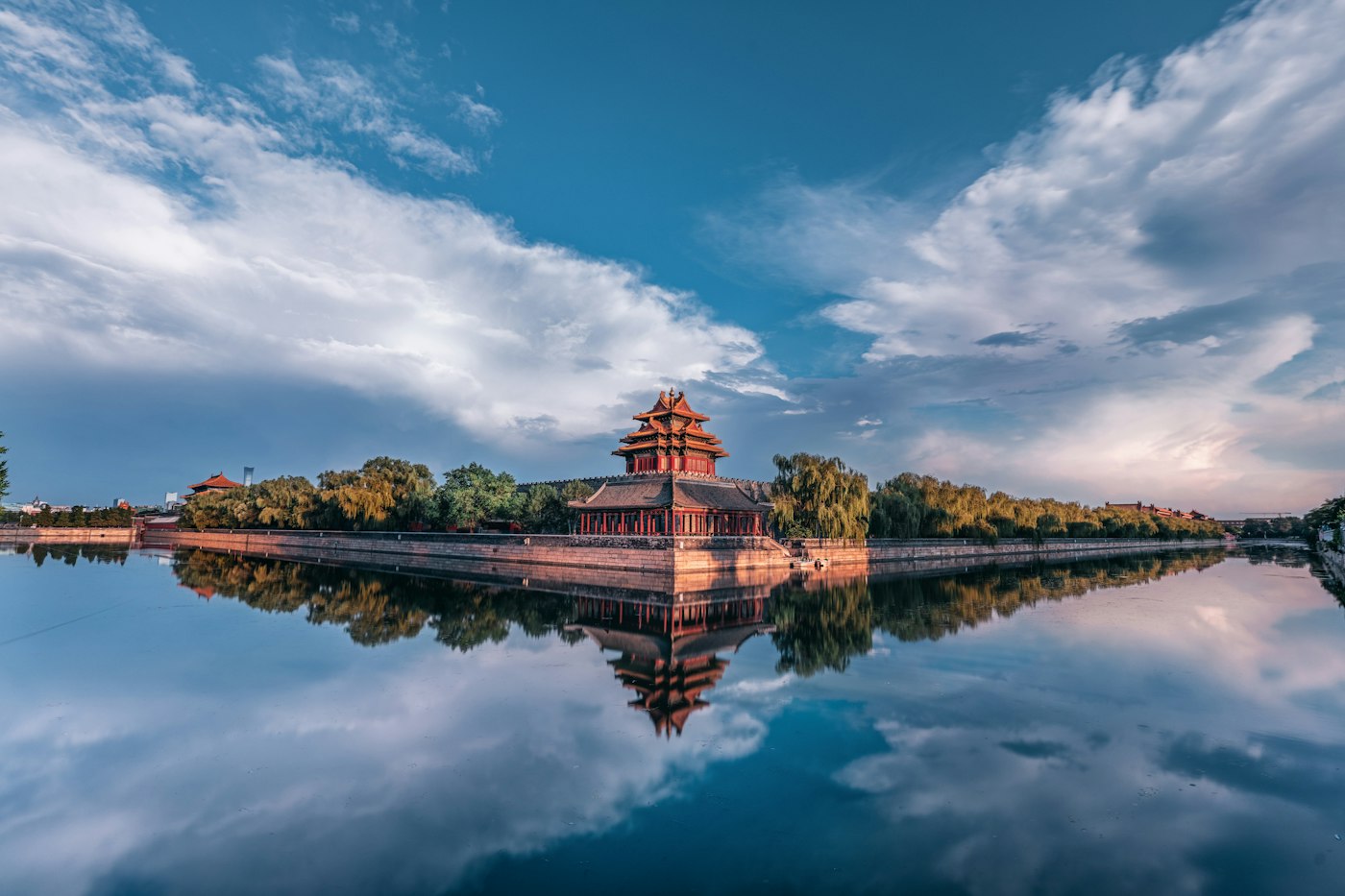
Clang, clang, clang. It’s the ubiquitous sound - that and the act of expectorating - that pervades the Chinese capital. It’s the sound of workmen, perched high atop skyscrapers, sheathed in miraculous bamboo scaffolding, hammering away at the new, all glass-and-steel Great Wall of China that is transforming Beijing for next year’s Olympics. Clang, clang, clang. After a few days in burgeoning Beijing, the surest means of escape from all of this cacophonous building activity is to head straight for the relative peace of the real Great Wall, an hour and a half or so from the capital.
It’s an early, chill morning at the start of the Chinese spring. I’m climbing a steep and rocky path to the Wall. At the top a thrillingly panoramic view of it is revealed, unravelling like a stalled, endless roller-coaster cascading up and down a series of stark mountains. It’s a relief, standing here alone with nary a single tour group in sight, to realise that, even in the world’s most populous nation, a moment of solitude remains achievable. This “untouristed” section of the Great Wall at Badaling runs directly through, and above, a unique hotel complex called Commune by the Great Wall. Here, as I’ve just experienced, you can step directly out the door of your luxurious villa and be atop this brick and mortar marvel within a quarter of an hour.
Commune by the Great Wall is the visionary creation of a couple of rich and forward-thinking Beijing developers. In a commendable folly they invited a dozen architects from across Asia to design a collection of radical villas that would be built and dotted around the craggy Walnut Valley. The villas, they surmised, would be readily snapped up as weekenders by China’s growing wealthy elite. But with strange names such as “Bamboo Wall House” and “Suitcase House”, the villas proved too avant-garde for conservative Chinese tastes. And, at $1000-plus a night, the cost of staying at one proved prohibitive for most foreigners. Even global acclaim, including a prestigious exhibition in honour of the project at the 2002 Venice Biennale, didn’t help.
Now, in a pragmatic but sensitive solution, each of the villas has been replicated and transformed into more than 200 luxurious, though considerably more affordable, hotel rooms and suites. Managed by the German Kempinski chain, the original buildings have been preserved in their intended form.
The story of commune by the great wall’s struggle to establish itself is a measure of how far a rapidly modernising China has journeyed architecturally. Beijing’s main Olympic stadium, an aquatic centre and the Digital Beijing Building (housing the technology to be used for the Olympics in a design that echoes a computer circuitry board on its side) are certainly radical. Beijing’s mammoth Olympic Green site is nearly large enough to render the Sydney Olympics an overblown gymkhana - and the Australian city’s Olympic Park was, to that point, the biggest concentration of Games venues in the event’s history.
It’s said that the Chinese build not to the scale of the human but to the scale of the human spirit. And whereas Sydney, for its 2000 Olympics, forgot to build any genuinely distinguished buildings (aside from a prize-winning railway station and a designer toilet block) Beijing is constructing a series of venues to ensure the world never forgets its Games, or the bill for staging them. Beijing academics Wang Junping and Liu Qiyun, writing in China National Condition and Strength (and reported by The Economist), last year calculated that China’s $35 billion Olympic expenditure would comprise 43 per cent of the total bill for all the Games, including Beijing, since Montreal in 1976.
Most Olympic cities, of course, are best viewed during and after the staging of a Games. Choosing to visit a host city in the year or so beforehand, with no firm plans to return for the event itself, is a little like attending the engagement party but not the wedding ceremony. But Beijing is different - with the speed and scope of its most remarkable transformation, it may well be the first host city best experienced before the opening ceremony. Well, almost. At least now, with less than a year to go before the Olympics open on August 8 next year, the visitor acquires a better sense of what the city used to be and what it could be in the future, beyond the Games.
Soon after i arrive in Beijing I check into its first design hotel, Hotel Kapok. One of the hotels closest to the Forbidden City, its former Mao-era facade is clad in an imposing jade-coloured lattice. Its rooms are stylish and spacious. And there’s an eye-catching central, glass-enclosed courtyard with a mass of suspended fairy lights that by night create a stunning illuminated indoor forest. Hotel Kapok has a lot to recommend it but with faltering service, staff with poor English and bar menus crudely handwritten in Texta, it provides an early sign that Beijing needs to inject more hop in its hip.
But there’s little time to linger at Hotel Kapok. I’ve received an invitation to an exhibition opening at the Australian-owned Red Gate Gallery at the fashionable 798 arts precinct on the other side of the city. There, I mention to one of the guests, an Australian expatriate, that the pilot of my plane from Hong Kong had, on our approach, warned of a dust-storm in Beijing (from the Gobi Desert, I assumed). “It was probably not from there at all,” the expat says. “It was more likely to be all of the dust from all of the construction sites around the city.” She disappears into a scrum of chardonnay-sipping fellow expats on the other side of the room before I can ask if she’s joking.
A few days later I’m in a car, being driven up a half-finished boulevard, when I score my first sight of the 90,000-seat, Swiss-designed Olympic stadium nicknamed “the bird’s nest”, a tangle of artfully twisted steel shimmering on a pillow of Beijing’s notorious smog, the containment of which has already cast a significant pall over the Games. The stadium is surrounded by a series of cranes that, perhaps appropriately, resemble birds, and which are dwarfed by the massive nest-like super-structure. From the official vantage point overlooking the stadium, an army of purposeful workers in yellow safety hats can be seen swarming over the site.
Beijing has clearly drawn its inspiration from the “best-ever” Games success of Sydney 2000. John Pauline is one of the Australian architects from the firm PTW responsible for Beijing’s Watercube, perhaps the most radical swimming centre ever built. The Watercube has been described as a celebration of “the splendour of transparency”, which you hope the Chinese authorities won’t misinterpret as some kind of veiled political statement. My first look at it makes me think of bubbles jammed into a water-filled shoebox. In reality, the Watercube is inspired by the arcane concept of the molecular structure of crystal cells, clad in a bubble-like high-tech plastic cladding.
“The Chinese are spending an enormous amount on infrastructure here,” Pauline says. “Beijing is a work in progress and what will emerge is hard to predict. But, really, the Olympics is a sideshow compared to the bigger picture of China’s overall growth. A lot of this investment would have occurred anyway - the Olympics are a happy coincidence.” Some coincidence. Pauline says the Chinese have “upped the ante” on the Olympic Games, with the size of the principal Beijing Games site exceeding even that of Sydney Olympic Park. “I think the Chinese respected what Sydney did in 2000, and there’s no doubt that they’ve used [the success of] Sydney as their benchmark. But the Chinese always believed they could do better.”
The extraordinary concept for the Watercube doesn’t belong to any one architect. Pauline explains the design emerged from a “boozy dinner” of architects back in Australia. Ultimately, the ∫Australians from PTW won the design competition to build it, along with the engineering firm Arup and a Chinese company.They beat the likes of Norman Foster and Partners (designers of Hong Kong’s acclaimed airport), who secured the contract to build the new Capital City Airport, which will feature the world’s biggest terminal, with the entire complex decked out in red and gold, symbolising a mythical Chinese dragon.
Perhaps the most dramatic single piece of architecture rising above Beijing is the futuristic, Dutch-designed CCTV Tower, the new headquarters of China’s national broadcaster. It’s claimed to be the second-biggest building in the world after the Pentagon in Washington DC.
The CCTV complex, one of an estimated 300 towers being erected in Beijing, will also include the striking companion piece Mandarin-Oriental, part of a “gotta-be-there” assault on the Chinese capital by the major international hotel brands. A lavish new 237-room Park Hyatt - “the first in Greater China” - is due to open later this year on the 40-kilometre-long main street, Chang’an Jie. Its top floor features a giant glass pyramid that mimics a Chinese lantern and will glow at night.
Not everyone is impressed by Beijing’s rapid modernisation. Beijingers, who have been among the harshest critics of the capital’s new architecture, have derided the incongruous new National Theatre, designed by the French architect Paul Andreu. It’s been likened to a giant steel egg splattered on a sensitive site near Tiananmen Square and the Forbidden City.
Back in Sydney, at the University of NSW, the outspoken author of New China Architecture, Professor Xing Ruan, is concerned that Beijing’s physical metamorphosis is becoming akin to an “architectural zoo” that risks developing into an “uncontrollable, monstrous explosion” of development. In Beijing, he contends, buildings are becoming more important as ostentatious objects than as functional entities. “Of course there are things to be excited about - [the Olympic buildings] are designed to create excitement. They’re striving to make a statement about the new modern China. They are metaphors for the euphoria that is sweeping the country.”
But Xing is concerned that such novel buildings - “ephemeral fashion pieces”, as he dubs them - will date in years to come, long after the Olympic circus has moved on and pitched its big top elsewhere. And like many observers, his greatest concern is the short-sighted demise, Singapore-style, of the city’s architectural heritage. With this degree of change being witnessed in Beijing, it’s no surprise that some of the ancient charm of the capital is being obliterated.
To experience that charm the visitor has to head to the disappearing hutongs, - and fast. Hutongs are Beijing’s unique network of historic narrow laneways of communal courtyard houses, where tightly knit communities once flourished. Once Beijing was an “ocean of grey”, a spectacle formed by the tonings of the tiled roofs of the hutongs ringing the Forbidden City. After the establishment of the People’s Republic in 1949, Chairman Mao Zedong launched old Beijing’s destruction, levelling much of the city, including its Ming-era city wall, along with the sub-dividing of courtyard homes and the introduction of industry closer to the city. Now his successors are trying to rid the city of factories that threaten the world’s expectation of a clean-air Games.
With many hutong residents being transferred to, or electing to go to, modern apartments around the capital and beyond, there now are only about 1200 surviving laneways. When I visit one of the courtyard houses, in lakeside Hou Hai, on a 700-year-old hutong, I pass labourers on a smoko playing mahjong from a board resting on the basket of a bicycle. One of the residents, housewife Wang Juzhi, is sitting in her living room surrounded by her extensive collection of Mickey Mouse ornaments. In the kitchen her younger brother is preparing a Chinese lunch for 20 foreign tourists who will pay for the experience of taking a meal in a traditional courtyard house. Although there have been well-publicised local protests against the destruction of the capital’s courtyard houses, when I bemoaned their demise to my twenty-∫ something female guide, she replied that most Beijingers are happy to transfer from their ancient hutongs to modern apartment blocks, with their proper plumbing and heating. But there’s no doubt that if Beijing doesn’t retain what’s left of its hutong heritage it will follow the same path as many other progress-obsessed Asian cities.
Brian Wallace came to Beijing 20 or so years ago from Australia as a Chinese language student and about five years later established the Red Gate Gallery. The gallery, which is now located in the landmark Dongbianmen Watchtower, hosts as many as eight solo contemporary art shows a year. It also provides much of the modern Chinese art that is a major feature of Commune by the Great Wall. Red Gate has encouraged overseas interest in modern Chinese art, including in Australia. When Wallace arrived in Beijing “there were bicycles everywhere and few cars, no neon, no tall buildings. Beijing was a sleepy town where all of the restaurants closed at 7pm because they were all government-run. As a foreigner it’s great to see the changes in Beijing but for the locals it’s even better because it’s come out of nowhere - except, that is, for the traffic and the pollution.” The momentum for change in Beijing, he believes, is now unstoppable, with the Communist Government drawing “a blank cheque” to modernise the capital in the name of the 2008 Olympic Games.
One of the great cultural anomalies of Beijing, if not China itself, is the 798 Dashanzi arts district (where Wallace operates a second gallery), on the site of an old electronics factory. The cavernous main exhibition hall was built by the East Germans in the Bauhaus-style and now houses galleries, artists’ studios, cafes and bars. As you wander around the complex’s dusty, industrial laneways, dipping in and out of its myriad galleries, you are left with two indelible impressions: how does this place manage to exist in one of the world’s most authoritarian societies, and why doesn’t every major city have an art precinct like it?
Among Red Gate’s artists is Zhou Jun. During my visit he shows me examples of his more recent works: arresting black-and-white images of Beijing with key sections highlighted in confronting scarlet bursts. He speaks of the “disposable” nature of contemporary Beijing and the almost “unnatural” pace of change. Beijing, he says, is becoming a city where only the “new” has value.
“Because of the Olympics the changes are huge. Development is a natural thing but here it’s so fast that even relatively new buildings are being demolished.” Zhou cites a report in a newspaper about Beijingers outraged by the demolition of a building just a decade old. Like most people you speak to in Beijing, locals and foreigners alike, Zhou says he’s still “trying to work out” precisely what sort of city is going to emerge after the biggest Olympic Games in history.
This quirky image by T+L reader Jackie Laws is the winner of the Travel + Leisure/Sony travel photography competition. More than 500 entries were received; a selection can be viewed in the Photoprize Gallery.